Laptop Rental vs Leasing India | What's the Difference? | Rentla
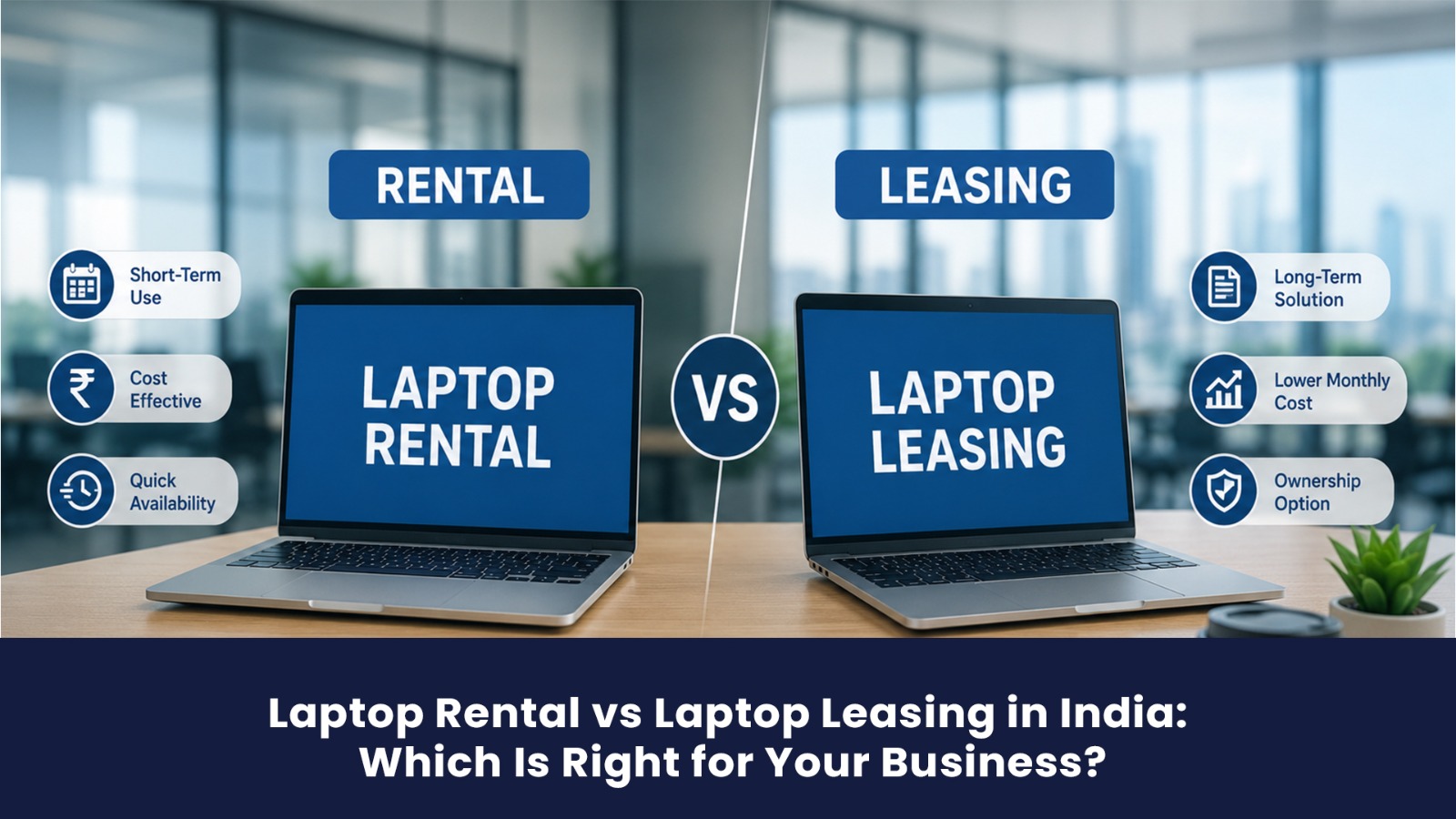
| Quick Answer | Quick Answer: Laptop rental and laptop leasing are structurally different products. Rental is a short-term, flexible agreement (1 month to 2 years) where the vendor retains full ownership and maintenance responsibility. Leasing is typically a longer-term financial instrument (2-5 years) with ownership transfer options at lease end similar to a hire-purchase arrangement. For most Indian businesses, rental is the more flexible and operationally simpler choice. Leasing suits large enterprises with stable long-term hardware needs. |
"Rental" and "leasing" are used interchangeably in casual conversation but they are different products with different financial treatments, contractual structures, and operational implications. Getting this wrong costs businesses time and money.
This guide explains the precise difference between laptop rental and laptop leasing in the Indian context, covers the financial and tax treatment of each, and gives you a framework for choosing the right model based on your business situation.
The Core Structural Difference
| Factor | Laptop Rental | Laptop Leasing |
| Ownership | Vendor retains full ownership throughout | May transfer to lessee at end of term |
| Typical term | 1 month to 2 years | 2–5 years |
| Maintenance | Vendor's responsibility | Usually lessee's responsibility |
| Balance sheet treatment | Off-balance-sheet (OpEx) | May appear as right-of-use asset (Ind AS 116) |
| Tax treatment | 100% operating expense in year incurred | Finance lease: depreciation + interest deduction |
| Early termination | Typically 30 days notice | Significant penalties in most lease agreements |
| Upgrade flexibility | High swap hardware at end of term | Low locked into specified hardware |
| RBI regulation | Governed by contract law | Some leasing structures regulated by RBI |
Financial and Tax Treatment in India
Laptop Rental OpEx Model
A rental payment is an operating expenditure under Section 37(1) of the Income Tax Act. The full monthly rental is deductible in the year it is incurred. GST at 18% applies; fully eligible for Input Tax Credit (ITC) for GST-registered businesses.
This is the cleanest accounting treatment: no asset on the balance sheet, no depreciation schedule, no disposal accounting.
Laptop Leasing Finance Lease vs Operating Lease
Under Ind AS 116 (applicable to listed companies and large enterprises), long-term leases that meet specific criteria are treated as finance leases:
- The leased asset appears on the balance sheet as a right-of-use (ROU) asset
- A corresponding lease liability is created
- Depreciation is charged on the ROU asset; interest is charged on the liability
- The tax treatment follows the accounting treatment for finance leases
For companies not required to apply Ind AS 116 (unlisted companies below the threshold), the distinction is simpler but the contractual terms still matter.
Practical implication: For most SMEs and growth-stage companies in India, the rental model's clean OpEx treatment is simpler and more tax-efficient than leasing's balance-sheet complexity.
When Leasing Makes Sense Over Rental
Leasing is appropriate in a narrow set of circumstances:
- Very long deployment horizon (4+ years): At 4+ years, the cumulative lease cost is typically lower than equivalent rental for the same hardware.
- Ownership transfer desired: Some lease agreements include a purchase option at the end of the term useful if the organisation wants to own the hardware eventually.
- Large enterprise with stable headcount: A 1,000-person company with zero headcount volatility over 5 years may find leasing economically optimal.
- Specialised hardware not available in rental fleets: Custom-specced servers or proprietary hardware not stocked by rental vendors.
When Rental Wins Over Leasing
For the majority of Indian businesses, especially tech companies, startups, and growth-phase organisations rental is the better choice:
- Headcount volatility: Add or remove units with 30 days' notice. A lease locks you in for 3–5 years.
- Technology refresh: Rental contracts allow hardware upgrades at the end of each term. A 5-year lease means using 5-year-old hardware at expiry.
- Maintenance-free: Rental includes maintenance and replacement leasing typically does not.
- Simpler accounting: Monthly OpEx with no balance sheet treatment preferred by most SME finance teams.
- Lower commitment: Start with a monthly term rather than a 5-year financial obligation.
Rentla's Position: Rental, Not Leasing
Rentla operates a pure rental model:
- Rentla retains full hardware ownership throughout the agreement
- Minimum term is 1 month; standard corporate terms are 6–24 months
- All maintenance, replacement, and data security is Rentla's responsibility
- Monthly GST invoice fully OpEx, fully ITC-eligible
- No ownership transfer at term end; hardware is returned to Rentla
- 30-day notice for full or partial return
This is deliberately simpler than leasing and for the businesses Rentla serves, it is the financially superior model.
Key Takeaways
- Rental and leasing are structurally different rental is flexible, maintenance-included, and off-balance-sheet; leasing is a longer financial commitment with ownership implications
- For Indian SMEs and growth-stage companies, rental's OpEx treatment (Section 37) and ITC eligibility make it the simpler and more tax-efficient choice
- Leasing is appropriate for very large enterprises with stable 4+ year hardware needs and an interest in ownership transfer
- Rentla operates a pure rental model 1-month minimum, full maintenance included, 30-day exit, no balance sheet treatment
- Never sign a "rental" agreement that includes a purchase obligation at term end that is a finance lease, not a rental
Frequently Asked Questions
Is laptop rental the same as an operating lease?
In everyday usage, yes laptop rental is treated as an operating lease or simply an operating expense. The vendor retains ownership, maintenance is included, and the payment is 100% deductible as an operating expenditure. In accounting terms, short-term rentals (under 12 months) are explicitly excluded from Ind AS 116's right-of-use asset requirement.
Does Rentla offer any form of lease-to-own arrangement?
No. Rentla is a pure rental company hardware ownership remains with Rentla throughout the agreement. There is no lease-to-own or purchase option at the end of the rental term. If your business needs to own hardware at the end of a period, purchase (possibly via EMI) is the appropriate route.
How is Rentla's rental treated in a company's financial statements?
Rentla's monthly rental payments are operating expenses recorded in the profit and loss statement. For rental agreements below 12 months (or low-value assets), no right-of-use asset or lease liability is created. For agreements above 12 months in companies applying Ind AS 116, a right-of-use asset treatment may technically apply confirm with your auditor based on your specific agreement terms and company size.
What is the difference between Rentla and a finance company offering laptop leasing?
A finance company offering laptop leasing typically structures the transaction as a hire-purchase or financial lease the business eventually owns the asset, and the payments are split into principal and interest. Rentla's rental is pure usage-based you pay for the right to use hardware you never own. The accounting, tax, and operational implications are completely different.
Renting IT equipment in Chennai?
Laptops, MacBooks and workstations for teams and projects, delivered, set up and supported. Rent one or hundreds.